


Working Moms Carry More: What the 2026 Pew Research Data Reveals about Parenting and Burnout


Burnout among parents, particularly working moms, is not a personal failing. It is now at the point of a structural crisis in the U.S., and new data from the Pew Research Center proves it.
A new study released in June 2026 of U.S. working parents found that 74% of full-time working moms don’t have enough time for hobbies, 71% can’t find time to see friends, and 67% don’t have enough time to simply relax.
This is what researchers call time poverty, and working moms are living in it every day for years...decades even.
A Mom and Founder’s Perspective on the Invisible Load
I spent 25 years in corporate America being the one who both worked full-time at my paying job outside the home and the one who remembered, and had to remember and do, everything for everyone in my family.
The school forms. The doctors appointments. The repair person who needed to be let in at 10 am on a Tuesday. The summer camp registrations. The birthday gifts. The list that never ended.

I was also building my career. Raising two kids with my husband who was also building his career. Trying to keep a household running.
And watching brilliant, highly capable women around me quietly step back. They weren't stepping back out of choice or lack of competency, but because the system and the employer had absolutely no give that worked.
Nobody was coming to help her or me. I tried lots of solutions out there like cheap virtual assistants, but none of them really helped. They couldn't run in-person errands, didn't know my local market well, were in the Philippines with a time zone and language barrier, and they simply didn't understand the to-do list of a mom.
So eventually I quit my job in leadership in the healthcare industry and decided I would build the help I needed myself. Today, that’s Sherah.
What the 2026 Pew Research Center Study Found About Working Moms
The Pew Research Center released its June 2026 report, “For Working Parents, the Boundary Between Work and Family Is Often Blurred,” based on a nationally representative survey of 2,242 U.S. working parents conducted March 2–15, 2026. The findings are striking.
For most working moms, the boundary between work and home doesn’t exist:

70% of working parents handle parenting tasks while they’re at work
59% handle work tasks while they’re with their kids
54% say balancing work and family is difficult
One mom in the survey captured it in a single sentence:
“I’m supposed to work like I don’t have kids and supposed to parent like I don’t have a job.”
That is not a personal failing of her or the millions of moms in the U.S. who are burned out. That is the reality of a culture that has been built without moms and families in mind, and the data backs it up.
What Is the Parenting Inequality Gap?
Parenting inequality is the gap between how much of the parenting load moms actually carry and how much their partners believe they carry. In households where both parents get paid to work full time outside the home, the Pew data reveals a stark perception gap:

63% of moms say they do more day-to-day parenting — only 41% of dads agree
63% of moms say they do more household chores — only 25% of dads see it that way
68% of moms say they are the one who takes off work for a sick child — only 29% of dads say the same about their partner
Same household. Two completely different realities.
What Is Time Poverty for Working Moms?
Time poverty is having so little personal time left after work and family obligations that rest, relationships, and self-care become unaffordable luxuries. According to the 2026 Pew Research study, among full-time working moms:
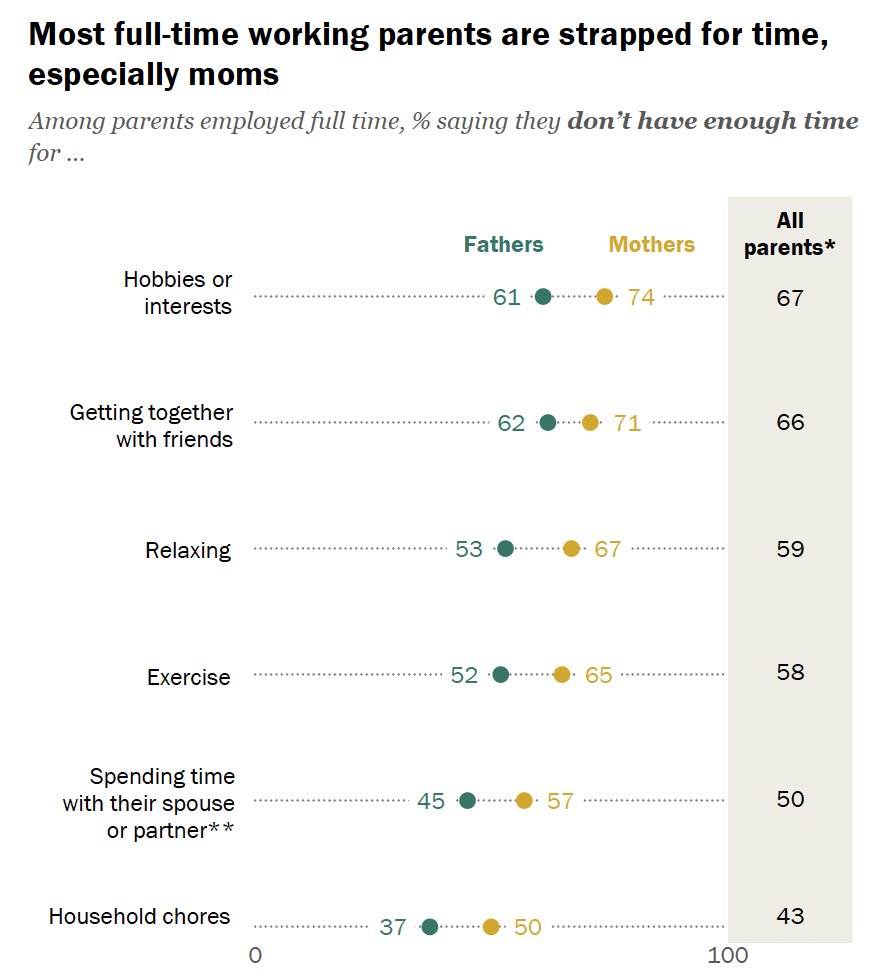
74% don’t have enough time for hobbies or personal interests
71% don’t have enough time to see their friends
67% don’t have enough time to simply relax
65% don’t have enough time to exercise
57% don’t have enough time for their relationship with their spouse or partner
These are not luxuries. These are the basics of being a human being. And working moms are running on empty across every single one of them.
“But Why Are You So Focused on Women?”
I get this question often. And here’s my current answer.

I see every day who comes through our website with lots of questions about how much they can trust the support we're offering, who actually joins Sherah, who puts in tasks for the whole family, who cries at their onboarding call with relief, who needs a check-in call to brain dump their life onto our team. I also hear from women across the U.S. at employers, conferences, networking events, and online about how much they are struggling to juggle it all. And in the end, the data keeps supporting the anecdotes and keeps bringing me back here.
When women are still the ones disproportionately stepping away from careers, cutting their hours, turning down promotions, and quietly absorbing the invisible work not because they want to, but because no one else is picking it up, I'll still be right here.
I focus on supporting women and their families because women are still carrying a disproportionate share of the load. When that changes, truly changes, I’ll broaden the conversation. But right now, the data says we’re not there yet.
“But Dads Are So Much More Involved Than They Used to Be!”
Yes. And I genuinely celebrate that. Dads showing up more is real, meaningful, and matters.

But "more than before" is not the same as "equal."
The same Pew report that shows increased dad engagement also shows that 63% of moms say they do more parenting — while only 41% of dads agree. It shows that 68% of moms say they’re the one who takes off work for a sick kid — while only 29% of dads say the same. And it shows that only 26% of moms are satisfied with how chores are divided at home, compared to 49% of dads.
Progress is real. Equality is not yet. And in the gap between those two things — between progress and equality — is where millions of women are quietly burning out.
What Is the Working Mom Satisfaction Gap?
The working mom satisfaction gap is the difference between how satisfied moms and dads are with the division of labor at home (even in households where both parents work full time.)
According to Pew:
Only 36% of moms are satisfied with how parenting tasks are split, versus 55% of dads
Only 26% of moms feel satisfied with the chore division, versus 49% of dads
When tasks are shared equally, mom satisfaction jumps to 65%. That's three times the 22% satisfaction rate of moms who carry more than their partner.
Equal is not idealistic. It is the difference between a mom who is surviving and a mom who is thriving.
This Is Why Sherah Exists to Help Busy Parents
Sherah is a personal assistant service built specifically for busy moms, by busy

moms, because no one should have to carry the invisible load alone.
Real, local, vetted support that actually shows up: for running errands, booking childcare, meal planning, managing home repairs, planning travel and parties, filling out school forms, planning and registering for summer camps, and the hundred invisible things that never make it onto anyone else’s to-do list but yours.
The data confirmed what we already knew. Now let’s do something about it.
Source: Pew Research Center, June 2026. “For Working Parents, the Boundary Between Work and Family Is Often Blurred.” Survey of 2,242 U.S. working parents, conducted March 2026.
Kristin Richardson is a mom and the Founder and CEO of Sherah, a personal assistant service for busy women and families operating across the U.S. She spent 25 years in corporate America before founding Sherah in 2022.
Frequently Asked Questions About Working Mom Burnout, Parenting Inequality, and the Mental Load/Invisible Load
What is time poverty for working moms?
Time poverty is when working moms have so little personal time remaining after work and family responsibilities that basic self-care — rest, exercise, friendships, and hobbies — becomes inaccessible. The 2026 Pew Research Center study found that 74% of full-time working moms don’t have enough time for hobbies and 67% don’t have enough time to relax.
What does the research say about parenting inequality?
According to Pew Research Center’s June 2026 study of 2,242 U.S. working parents, 63% of moms say they do more day-to-day parenting tasks, while only 41% of dads agree. This perception gap — the difference between how moms and dads see the division of labor — is what researchers and advocates call parenting inequality.
Why are working moms more burned out than working dads?
The 2026 Pew Research data shows that 67% of full-time working moms say they couldn’t give 100% at home due to work demands, compared to 50% of dads. Moms are also significantly more likely to handle parenting tasks during work hours, take time off for childcare emergencies, and report dissatisfaction with how household responsibilities are divided.
What is Sherah and who is it for?
Sherah is a personal assistant service founded by Kristin Richardson, built for busy women, moms, parents, and families of all kinds. Sherah provides real, local, vetted support , both virtually and in-person, including running errands, booking childcare, completing home repairs, planning travel and birthday parties and more, to help parents reclaim their time and reduce the invisible load they carry.


Comments